
“May the Lord give you peace.”
Pope Leo highlights this famous greeting of St. Francis of Assisi and places the notion of “Peace” at the heart of this Jubilee year of grace. In his prayer to St. Francis asking for his special intercession, the Pope recalled that St. Francis was a person who sought and lived peace:
“Saint Francis, our brother, you who eight hundred years ago went to meet Sister Death as a man of peace, intercede for us before the Lord.
You recognized true peace in the Crucified of San Damiano, teach us to seek in Him the source of all Reconciliation that breaks down every wall.
You who, unarmed, crossed the lines of war and misunderstanding, give us the courage to build bridges where the world raises up boundaries.
In this time afflicted by conflict and division, intercede for us so that we may become peacemakers: unarmed and disarming witnesses of the peace that comes from Christ. Amen”
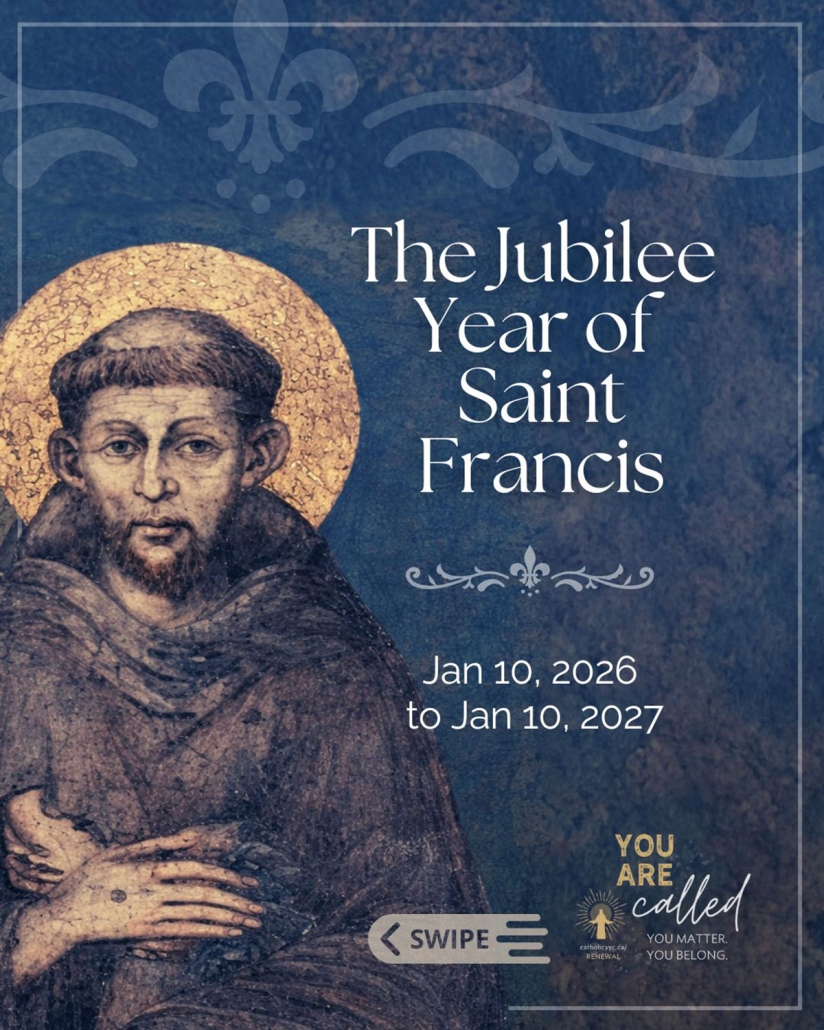
This Jubilee year of grace invites us to find inspiration in the life and witness of St. Francis for our own journey of faith, so we also becoming models of holiness and constant witnesses of peace.
Francis was a particular witness of peace in his time: born into a life of privilege, he renounced all to follow the way of the Crucified Saviour, allowing Christ to be his source of peace. In humility and simplicity he became detached from all desire for power, possessions or social status. Not needing to defend or protect anything, he went to the margins of society and served those in whom he recognized the face of the suffering Christ. Desiring to proclaim the message of reconciliation and peace to all people, he crossed boundaries and through his respectful witness engaged with Sultan Malik Al-Kamil, earning the high regard and favour of this religious leader.
It is fitting in this Jubilee year that the Pilgrim Church of Christ be reminded that we too follow in the footsteps of Jesus and are called to conform our lives to his, just as St. Francis did. As Francis told his followers as he was close to death, “I have done what is mine to do. May Christ teach you what is yours.”
And what does Christ teach us? How do we live from a heart filled with the peace that only Christ can bring? The first requirement is receive the Good News proclaimed by Christ and to do as Francis did: be receptive to the grace that changes our lives – metanoia. “The time is fulfilled, and the kingdom of God has come near; repent, and believe in the good news!” (Mark 1:15) We, like Francis, are called to cling no longer to that which does not lead to peace in Christ: greed, inordinate ambition, arrogance, self-righteous judgments against others, pursuing our own selfish interest and desires without due regard for the needs and dignity of others. At his lowest point, Francis recognized his poverty before God and opened himself to becoming a vessel that God could use to advance the kingdom of peace. We are invited to recognize our own poverty, placing all into the hands of Christ to do with us as God the Father wills for us – discovering our unique mission of peace building and peace making.
St. Francis did not see himself as a saint. He, in fact, understood himself to be a sinner, forgiven and in constant need of God’s grace and mercy. The life of penance he embraced was motivated by his love of God and desire to be a willing instrument in God’s hands.
God’s mercy is a constant focus within Church teaching. Recalling God’s indulgent mercy, Bishop Krzysztof Nykiel, Regent of the Apostolic Penitentiary which published a decree on God’s indulgence available this Jubilee year, reminds us that God’s grace can transform even our greatest weaknesses. God’s indulgence makes it possible to free the heart from the burden of sin and purify, heal the harm sin causes.
The Church developed its teaching on indulgences from this notion of God’s mercy which is more that we can fully take in or comprehend. In its essence, an indulgence reaffirms the forgiveness of sins and the healing and purification of the heart from the consequences of sin that comes as one allows God’s grace to transform one’s life. God’s indulgence is always available to us. “It is essential to understand that indulgence is first and foremost an encounter with God, and that its power lies not in our human efforts, but in the grace of God that transforms hearts… All penitential practices – such as confession, Communion, pilgrimage, prayer – are instruments of preparation that facilitate the encounter with God, but they do not replace the experience of grace itself. The authentic fruits of indulgence appear with a person consciously opens themselves to God’s transforming power, allows God to act in their heart, heals relationships, forgives, and is converted.” (Bishop Krzysztof Nykiel, quoted from “Indulgence is an Encounter with God, not a Spiritual Shortcut,” by Fr. Marek Weresa, Vatican News, January 16, 2026)
While the Church has established common practices which give expression to one’s interior desire to detach from sin, surrender to God’s mercy and be receptive to God’s grace – including sacramental confession and participation in the Eucharist and reception of Holy Communion – “at the heart of the practice of indulgences is God’s love, always calling us to grow in holiness. Living out indulgences is not just about fulfilling a list of requirements; it is an opportunity to open our hearts to divine grace and to the intercession of the saints.” (Bishop Lucia, “Indulgences Explained,” from The Catholic Sun, April 10, 2025)
God moves in our hearts at all times and everywhere. During this Jubilee year of St. Francis, we are invited to find meaningful ways to grow in our relationship with God and in love of our brothers in sisters which reflect the path of St. Francis. Some of the particular ways may include making a pilgrimage to a place of worship dedicated to St. Francis, praying with the same words he used before the crucifix at San Damiano – “O most high, glorious god, enlighten the darkness of my heart and give me a right faith, a certain hope and a perfect love, understanding and knowledge, O Lord, that I may carry out your holy and true command”; praying the Way of the Cross which became associated St. Francis after he promoted this devotion on his return from the Holy Land; praying before the Blessed Sacrament, mirroring the same desire of St. Clare of Assisi of giving yourself totally to the One who gave himself totally to you; meditating prayerfully (Lectio Divina) on a passage that reflects the spirit of St. Francis; finding concrete ways to serve the poor Christ in the suffering and marginalized; becoming an unarmed and disarming peacemaker in your home, community and workplace; spending time contemplating creation and the many ways it reflects God’s goodness and beauty; praying the Seven Joys of Mary, a particular Franciscan rosary which honours the joyful mysteries of the Virgin Mary’s life. During Lent the Seven Sorrows of Mary are prayed; uniting your personal suffering, difficulties, illness, and diminishment in the same spirit of St. Francis who wrote the Canticle to the Creatures which exhorting God’s praise, all while blind and close to death.
As you take advantage of this Jubilee Year of St. Francis, may you hear St. Francis’ blessing addressed to you: “May the Lord bless you and keep you; May He show His face to you and have mercy on you; May He turn his countenance to you and give you peace.” (Numbers 6: 24-26)

